
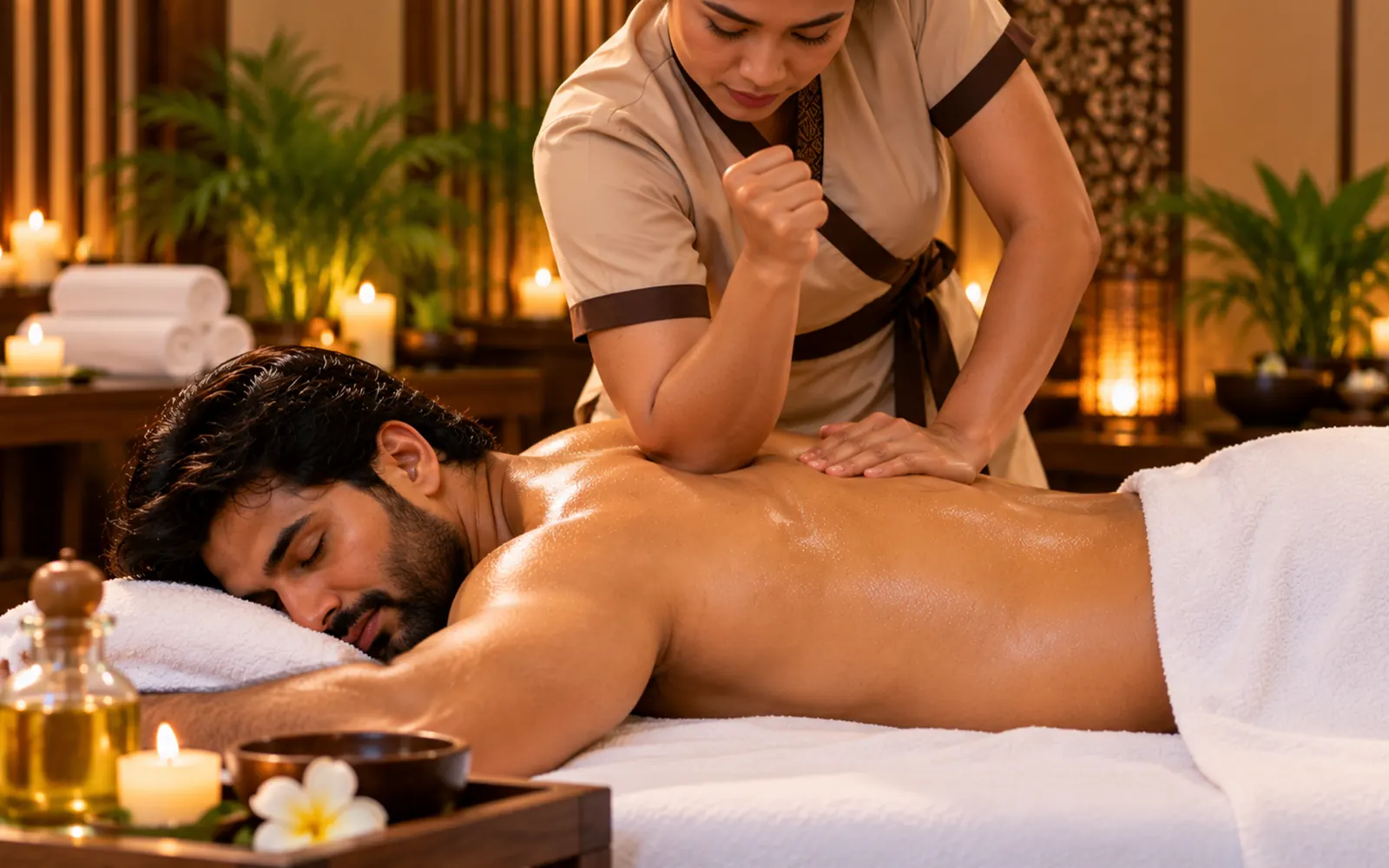
Deep tissue massage uses slow, firm pressure on tight muscles in the shoulders, neck, back and legs; at Olive Spa it starts from AED 120 and the pressure is agreed with you first.
Key takeaways
- Best for knots and desk-tight shoulders rather than general relaxation
- Firm but never painful: aim for about 6 or 7 out of 10
- Choose 60, 90 or 120 minutes; 90 suits most knots
How we work: The first minutes are always lighter, so the muscles warm up before firmer pressure begins.
Further reading: Massage (Wikipedia)
What is a deep tissue massage?
The short answer: Deep tissue massage is a massage style that uses slow strokes and firm, focused pressure to reach the deeper layers of muscle and the connective tissue around them. Therapists use their thumbs, palms, knuckles and forearms, working gradually from lighter pressure to deeper pressure so that the muscles have time to soften rather than resist.
Compared with a lighter relaxation massage, a deep tissue massage typically:
- uses less oil, so the therapist can work more precisely
- moves more slowly, sometimes holding pressure on one spot
- spends more time on fewer areas, according to what you ask for
- feels stronger, especially across the shoulders and along the spine
What we will not tell you is that deep tissue massage cures anything. It is not a medical treatment, and it is not a substitute for physiotherapy or a doctor’s advice. What you may notice afterwards is simpler: their shoulders feel lower, their neck turns more easily, and they feel lighter.
Duration and price
| Treatment | Time | Price |
|---|---|---|
| Deep tissue massage | 60 minutes | From AED 120 |
| Deep tissue massage | 90 minutes | AED 180 |
| Deep tissue massage | 120 minutes | Ask us when you book |
A 90-minute session is worth considering if you want both your upper body and legs worked properly without rushing either. See every option on the spa menu.
Does deep tissue massage hurt?
The short answer: This is the most important question, so here is a straight answer: it should feel strong, but it should not hurt.
There is a difference between productive intensity and pain. Productive intensity is a deep pressure you can breathe through, sometimes with a feeling of “that’s the spot.” Pain is when you tense up, hold your breath, grip the table or pull away. When your body tightens against pressure, the massage stops doing its job.
We use a simple scale during the session:
| Your number | What it feels like | What to do |
|---|---|---|
| 1–3 | Light, soothing | Ask for “firmer” if you want deeper work |
| 4–6 | Firm, comfortable | A good range for most of the session |
| 7 | Strong, intense, you can breathe through it | The upper limit for short periods |
| 8–10 | Painful, you tense up | Say “lighter” immediately |
Your therapist will ask you for a number once or twice, particularly on the back and shoulders. You can change your mind at any point. Saying “lighter” is never rude, and nobody will think you are not “tough enough.”
Your deep tissue session, step by step
- Book and tell us what is tight. Use the booking form, call us or send a WhatsApp message. Mention the areas you want worked on and any injuries.
- Allow 10 to 15 spare minutes before you start. Head up to the 1st Floor of V Hotel Fujairah, Al Fassel Rd, for your deep tissue session. Take a moment to settle and complete a short form.
- Consultation. Your therapist asks about focus areas, preferred pressure, and anything to avoid. Your focus areas and pressure are confirmed here.
- Warm-up. The session always starts lighter. Muscles need warming before deeper pressure.
- Focused work. Slow, firm pressure on the areas you chose, with check-ins on the 1–10 scale.
- Easing out. Lighter strokes to finish, then a few quiet minutes before you get up.
- Aftercare tips. Your therapist may suggest water, gentle stretching or rest for the evening.
Is deep tissue massage right for you today?
The short answer: deep tissue suits you when you can point to where it feels tight. These signs usually mean it is a good fit:
- Your shoulders, neck or upper back feel knotted after long hours at a desk or behind the wheel.
- Your calves, thighs or lower back feel tight after training, hiking or standing all day.
- You have enjoyed firm pressure before and know that a light massage does not reach the tension.
It may not be the best choice if you mainly want to drift off, if you bruise easily, or if you are recovering from an injury that has not been checked. In those cases, tell us and we will keep the pressure lighter.
How we agree the pressure with you
Pressure in a deep tissue massage is never a surprise. Before you lie down, your therapist asks where it feels tight and how firm you like it. During the session, they check in, especially when they first reach a knot.
A simple scale helps. If 1 is barely touching and 10 is too much, around 6 or 7 out of 10 on the tight areas, and lower elsewhere, is a sensible target. Say a number at any time and the therapist will adjust. Holding your breath or tensing up is a sign the pressure is too high, so we will ease off if we notice it.
Who tends to prefer deep tissue massage?
The short answer: Deep tissue massage is often chosen in situations like these:
- Office and screen workers whose upper back and neck stay tight from long hours at a desk or on a phone.
- Drivers and commuters travelling between Fujairah, Dubai, Sharjah and the East Coast, who feel it in the lower back and shoulders.
- Gym-goers, runners and padel players who like firm work on their legs, hips and back on rest days.
- Hikers back from Wadi Wurayah or the Hajar Mountain trails who want their legs looked after.
- Regular massage guests who already know they prefer a stronger touch.
Deep tissue is not always the right first choice. If you have never had a massage before, or you are not sure how you respond to pressure, ask for a lighter deep tissue session that focuses on one area. You can move to deeper work next time.
When your shoulders have been working overtime
If your shoulders have been creeping up toward your ears, you probably already know it. Maybe you notice it at the end of a long day at the screen, or in the car on the Sheikh Khalifa highway, or the morning after a hike into the Hajar Mountains. There is a tightness that a gentle massage does not quite reach: a feeling that the muscles have forgotten how to let go.
A deep tissue massage is for that feeling.
It is slower and firmer than a relaxing massage. Instead of covering the whole body evenly, your therapist spends more time where you hold the most tension (often the upper back, neck, shoulders, lower back and legs) and works with steady, sustained pressure. It can be intense. It should never be a test of endurance.
At Olive Spa, inside V Hotel Fujairah, every session starts with a conversation, because the right pressure for you is not the same as the right pressure for the next guest.
When to check with a doctor first
Your comfort and safety come before any booking. Please tell us before your session, and consider speaking with your doctor first, if you:
- are pregnant
- have had surgery, a fracture or a sprain recently
- have a blood clotting disorder or take blood-thinning medication
- have varicose veins, skin conditions or open wounds in the area
- have osteoporosis, a disc problem or a nerve condition
- have a fever or feel unwell
In some of these cases we will adjust the treatment, avoid an area or suggest a gentler option. In others we may ask you to come back once you have medical clearance. We would rather you enjoy your massage safely than book the wrong one.
Not sure how firm to go? We can advise.
Aftercare: getting the most from your massage
Firm work can leave you feeling loose and a little tired. These simple steps help:
- Drink water over the next few hours.
- Keep the evening easy. A short walk is fine; a heavy workout is better left until tomorrow.
- Have a warm shower rather than a very hot sauna straight away.
- Notice how you feel the next day. Mild tenderness for a day or two is common after firm pressure. Sharp or lasting pain is not, so please let us know.
Drink some water, keep the worked areas warm, and save hard exercise for the following day.
Why book deep tissue massage at Olive Spa?
- Pressure agreed, not assumed. We talk first and check in during the session.
- Focus where you need it. You choose the areas, and the session stays on them rather than following a fixed routine.
- Private rooms in a hotel setting. Quiet, clean and calm, inside V Hotel Fujairah.
- Honest advice. If we think a different treatment will suit you better, we will say so.
- Simple booking. Online, by phone or on WhatsApp, for hotel guests and visitors.
Helpful guides
At a glance
- Pressure
- Medium-firm to firm, agreed first
- Oil
- A little
- Focus
- Shoulders, neck, back and legs
- Length
- 60, 90 or 120 minutes
- Price
- AED 120+ for an hour, AED 180 for 90 minutes
- Best for
- Knots and desk-tight shoulders
Book your deep tissue massage in Fujairah
If something in your back or shoulders has been asking for attention, let’s give it some. Choose your time, tell us where it feels tight, and we will agree the pressure together before we start.
Reserve your deep tissue session through the booking page, by phone on +971 54 594 0701, or on WhatsApp (+971 50 271 8276). Tell us which areas feel tight when you book, so your therapist can plan the session.